REVIEW · CATANIA
Catania Walking Tour with Audio and Written Guide by a Local
Book on Viator →Operated by Walking Cap · Bookable on Viator
Catania explains itself at your pace. This Catania Walking Tour with Audio and Written Guide is a self-guided loop of the historic center where your phone delivers stories, directions, and local context as you go. You get audio plus text in several languages, linked to Google Maps, so you’re not stuck guessing what you’re looking at.
I love the value: about $7.83 for 3 to 4 hours, with most stops free to enter. I also like the flexibility of a start-and-stop route that fits your speed, not someone else’s schedule.
One thing to weigh: it depends on your smartphone with internet, and one key site (the Roman amphitheatre) needs a separate €4 ticket.
In This Review
- Key highlights at a glance
- A Self-Guided Catania Walk With Audio and Written Guidance
- Price, Time, and What You Really Get for $7.83
- Before You Go: Smartphone Setup and Sound Tips That Matter
- Ursino Castle Square: Lava-Stone Fortress by the Water’s Edge
- A’ Piscaria Mercato del Pesce and Fontana dell’Amenano
- Piazza del Duomo and the Cathedral of Sant’Agata After 1693
- Piazza Università Legends and the Roman Amphitheatre Ticket Choice
- Via dei Crociferi: A Film-Look Street in the Middle of Real Life
- Benedictine Monastery of San Nicolò l’Arena: Ending at a Major Cultural Anchor
- How to Pace This Walk Like You Mean It
- Who This Digital Audio Tour Fits Best
- Should You Book This Catania Audio Walk?
- FAQ
- How long does the Catania walking tour take?
- What languages are included in the audio and written guide?
- Are headphones included?
- Is the Roman amphitheatre included in the tour?
- What do I need on my smartphone to use the guide?
- Can I cancel for a full refund?
Key highlights at a glance

- Multilingual audio + text (English, Spanish, Italian, German, French) that keeps you oriented
- Free entry at most stops, so your spend stays low compared to guided tours
- Google Maps support, making it easier to find each monument and get back on track
- A strong mix of Catania’s “layers”: medieval castle, baroque cathedral, legends, and Roman remains
- Local food guidance inside the digital guide (so you’re not eating the tourist menu)
- Smartphone-first setup: headphones optional, but you must plan for sound and battery
A Self-Guided Catania Walk With Audio and Written Guidance
This is the kind of city experience I enjoy most: you walk, you look, and your phone quietly explains what matters. Instead of following a live guide who rushes to cover everything, you control the pace. That matters in Catania, where street life and architecture change block by block.
What makes this tour work well is the structure. You move from Ursino Castle through the historic center, hitting a classic arc of sights tied to the city’s identity: lava-rock fortification, Catania’s fish market culture, the city’s patron-saint core, and the legends built into public spaces.
And because the guide includes audio and text, you can choose what you prefer in the moment—listen while standing in the plaza, then read later if you want names and details.
You can also read our reviews of more walking tours in Catania



Price, Time, and What You Really Get for $7.83

At roughly $7.83 per person, you’re paying for interpretation and navigation, not admission tickets. The schedule is about 3 to 4 hours, which fits a half-day plan without exhausting you. Most stops are marked as free, so the cost stays anchored.
The big value move here is that the guide isn’t just “talking points.” You also get:
- Tips for monuments, history, and curiosities
- Best advice for local restaurants with authentic food
- A connected Google Maps experience so you can find your way
The only paid add-on is the Anfiteatro Romano, which costs €4 and is not included. If you’re the type who likes to see Roman ruins up close, factor that into your budget.
Before You Go: Smartphone Setup and Sound Tips That Matter

Because this is digital, preparation is part of the experience. You’ll need a smartphone with an internet connection to use the guide, and the activation details are provided with your voucher. Bring a charged battery and, ideally, a power bank if you’re out all afternoon.
Headphones are also a planning detail. The tour notes that headphones are not included; you’ll hear audio through your phone’s speakers, or you can use your own headphones if you have them. If you’re in a louder street moment, your own headphones can be the difference between understanding the story and nodding along politely.
Finally, give yourself realistic time to reach the start point. The walk begins at Ursino Castle, Piazza Federico di Svevia 21. If you’re arriving from farther away, don’t wait until the last minute to start.
Ursino Castle Square: Lava-Stone Fortress by the Water’s Edge
Your walk opens at Ursino Castle, a major anchor in central Catania. Even before you read any details, the feel of the place tells you it was built for defense. The castle’s name is linked to Frederick II of Swabia, and the setting is tied to a time when the sea was closer than it is today.
The guide focuses on how the castle’s walls were constructed. You’ll learn how the exterior wall used squared, regularly arranged lava stone ashlars, while a second inner wall is more irregular. That contrast helps you understand the fortress as a working structure, not just a postcard building.
Practical note: since this stop is marked as free admission, you can spend time here without worrying about extra costs. If you like your photos with strong geometry and texture, this is a good first stop to set the tone for the rest of the walk.
A’ Piscaria Mercato del Pesce and Fontana dell’Amenano

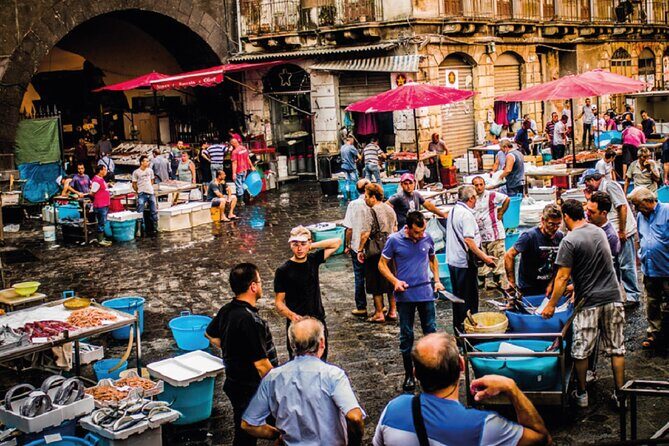
Next you head into one of Catania’s most recognizable rhythms: food. A’ Piscaria (Mercato del Pesce) is the city’s fish market in the historic center, near Piazza del Duomo and the Fontana dell’Amenano. The local name “Piscarìa” comes from Sicilian dialect, and the guide uses that kind of detail to make the place feel more specific than a generic market stop.
This is also a great moment to slow down and watch. Even if you don’t buy anything, markets are where you learn how locals move through the day. The market stop is short—around 20 minutes—but it’s long enough to take in the atmosphere and get your bearings for the Duomo area.
Right after that, the tour points you to the fountain’s story. Fontana dell’Amenano was created in 1867 by sculptor Tito Angelini in Carrara marble. The fountain is dedicated to the Amenano, the underground river that flows beneath the city of Etna. That detail changes how you see the fountain: it becomes a map legend made of stone.
You can also read our reviews of more guided tours in Catania





Piazza del Duomo and the Cathedral of Sant’Agata After 1693

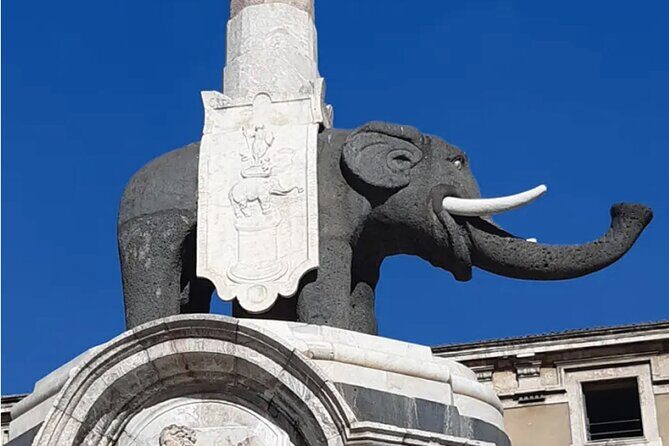
Then comes the heart of Catania: Piazza del Duomo. The guide frames this square as the city’s central gathering space and links it to key monuments—especially the Cathedral of Sant’Agata, Catania’s patron saint.
Take your time here, even if you’re only scheduled for about 20 minutes at the cathedral area. The cathedral itself is Baroque in style, and the guide explains how it sits on older layers. The cathedral was built in 1090 on the remains of an ancient Roman temple dedicated to Jupiter, which is one of those facts that makes old cities feel like they’re built on top of each other on purpose.
The other crucial chapter is the 1693 earthquake. Much of the city was destroyed, and the cathedral was rebuilt afterward. Standing in the area, you can feel why that matters: Baroque architecture often reads as theatrical, but in places like this it also carries survival and rebuilding in its bones.
Piazza Università Legends and the Roman Amphitheatre Ticket Choice

At Piazza Università, the guide shifts from major monuments to the kind of detail that makes a city feel lived-in. The square’s name links to the Palazzo degli Studi, and the highlight for many people is the set of four bronze lampposts at the corners.
Each lamppost represents a figure from local legend:
- Gammazita
- Cola Pesce
- brothers Anfinomo and Anapia
- paladin Uzeta
This is the sort of stop that’s quick on paper (about 10 minutes) but memorable. You’ll spend a little longer looking if you enjoy stories that people actually use to explain the landscape.
Then you’re offered a choice: Anfiteatro Romano beneath Piazza Stesicoro. The Roman theatre dates back to the 1st century BC, and it’s been submerged over time by eruptions of Etna and seismic events. The tour explicitly suggests you won’t enter as part of the guided flow, but you can visit on your own.
If you want to see inside, you’ll pay the separate €4 ticket (not included). This is worth considering based on your interests. If you love archaeology, it’s a small add-on for a meaningful payoff. If your priority is the visible streetscape and main monuments, you can treat it as an optional branch without breaking your budget.
Via dei Crociferi: A Film-Look Street in the Middle of Real Life
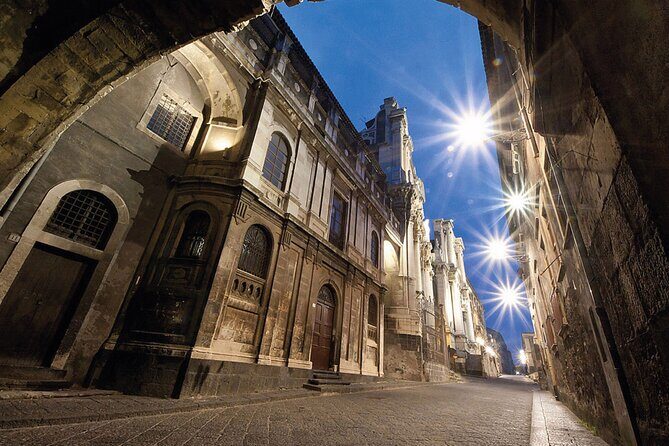
Now you walk along Via dei Crociferi, one of Catania’s oldest and most evocative streets. The guide points out its cinematic charm, and that’s how it often feels on arrival: a street with symmetry, dramatic facades, and perspective that naturally frames photos.
You’ll only spend about 10 minutes here, but this is a good stretch to reset. It’s also a practical breather between big-ticket sights, letting you walk, take in small details, and not overload your brain. The street’s popularity as a setting makes it a useful place to compare what you see in real life versus what you’ve seen in film.
Benedictine Monastery of San Nicolò l’Arena: Ending at a Major Cultural Anchor
Your finish point is Benedictine Monastery of San Nicolò l’Arena, located at Piazza Dante Alighieri 32. This stop matters because the guide treats it as more than a pretty building. In Catania’s timeline, the monastery is described as a key reference point—especially in the eighteenth century—with grandeur and richly developed rooms.
The guide also highlights the noble origins of the monks who lived there. That detail helps you understand why monasteries like this often shaped cities beyond religion: they were centers of order, learning, and influence.
You’ve got about 30 minutes here, and because the tour is digital, you can stop at your preferred moment rather than rushing for a group departure. The monastery makes a satisfying close because it feels like a “root” location: you leave with a sense of how the city organized power and culture.
How to Pace This Walk Like You Mean It
The tour is designed for self-paced movement, so the best strategy is simple: keep your phone audio on while you’re walking between stops, then pause at each site and listen when you’re stationary. That’s when you’ll catch the key facts.
Here’s what I’d do in real life to make it feel worth it:
- At each stop, pick one theme (fortress building, underground river, post-earthquake rebuild).
- Spend extra time at Piazza del Duomo if you enjoy architecture and dramatic spaces.
- Decide early about the Roman amphitheatre (since it requires a separate €4 ticket), so you don’t feel rushed later.
- Use Google Maps guidance if you drift off-route, especially in the central historic streets where lanes can look similar.
Also, keep your phone on low power mode only if it doesn’t affect audio. You want clear listening in open-air plazas.
Who This Digital Audio Tour Fits Best
This works best if you like controlling your own time. You don’t need to coordinate with a fixed meeting schedule once you’ve started; you can pause, linger, and adjust your route without feeling like you’re falling behind.
It’s also a good fit if you:
- want English availability (and multiple other languages if needed)
- enjoy learning through audio plus text, not just one format
- care about value and prefer spending money on meals over museum tickets
- like having restaurant recommendations in your pocket during the walk
If you strongly prefer a live human guide who can answer questions on the spot, this format may feel less satisfying. It’s still well structured, but it’s designed for self-guided wandering.
Should You Book This Catania Audio Walk?
I’d book it if you want an affordable way to see the central sights of Catania with context that actually sticks. For $7.83, you’re getting a structured route, multilingual audio/text, Google Maps help, and tips for food—most of it without extra admission costs.
I’d think twice if your smartphone battery is unreliable or you hate depending on internet for your plan. Also, budget the €4 amphitheatre ticket if Roman ruins are your thing.
If you’re the kind of person who likes to walk, look, and learn without a rigid schedule, this is a smart buy.
FAQ
How long does the Catania walking tour take?
It’s approximately 3 to 4 hours.
What languages are included in the audio and written guide?
The guide includes audio and text in English, Spanish, Italian, German, and French.
Are headphones included?
No. You’ll use your smartphone’s audio, or you can use your own headphones if you have them.
Is the Roman amphitheatre included in the tour?
You can visit the Roman amphitheatre, but the ticket is not included. The amphitheatre ticket costs €4.
What do I need on my smartphone to use the guide?
You need a smartphone with an internet connection to use the digital guide, and you’ll receive activation details in your voucher.
Can I cancel for a full refund?
Yes. You can cancel up to 24 hours in advance for a full refund.