REVIEW · CATANIA
From Catania: Mount Etna Guided Panoramic Trek
Book on GetYourGuide →Operated by Etna Hiking · Bookable on GetYourGuide
Etna feels close up on this hike. What I like most about the Mount Etna Guided Panoramic Trek from Catania is the naturalist approach, especially with guide Alessandro, who breaks down the volcano in clear English. I also love the contrast of scenes: crater hollows, colored Silvestri Craters, and that run-wild-on-black-lava-sand feeling when you head back downhill.
Now, one heads-up: this is a real hike. Expect a 6 km steep loop on volcanic material at high altitude, and you’ll want basic physical fitness for the climb and the footing.
In This Review
- Key highlights you should care about
- Why this Etna trek feels more real than a drive-by
- Meeting in Catania: simple pickup, small-group advantage
- Gear and the hike reality: what “basic fitness” really means
- Stop-by-stop: what you’ll do from pickup to drop-off
- Stop 1: Your Catania meeting point
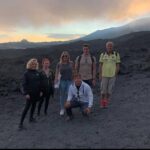
- Stop 2: The guided Etna hike (around 3.5 hours)
- Lunch break at 2,400 meters
- Stop 3: Return to your drop-off point
- The view payoffs: Silvestri Craters and Valle del Bove
- Lava tunnels: what you gain, and what can change
- Downhill on black lava sand: when “hike” turns into play
- Naturalist learning that actually connects
- Price and value: is it worth $62.63?
- Who should book this Etna hike, and who should skip it
- Practical tips for a smoother Mount Etna day
- Should you book Mount Etna Guided Panoramic Trek?
- FAQ
- How long is the Mount Etna Guided Panoramic Trek?
- Where does the tour start in Catania?
- How high do you hike on Mount Etna?
- Is food included in the tour price?
- What gear is included?
- What is not included?
- Can the lava cave visit be canceled?
- What is the hike distance and difficulty?
- What languages is the guide speaking?
- Is there free cancellation?
Key highlights you should care about
- Naturalist guide + real geology: you get explanations tied to what you’re walking on
- From 1,800 m to 2,400 m: high-altitude views and cooler air than at sea level
- Black lava “downhill play”: run on volcanic sand like you’re 10 again
- Lunch at 2,400 m: a quiet break with volcano sounds in the background
- Small group (max 10): easier pacing and better chances to ask questions
Why this Etna trek feels more real than a drive-by
Mount Etna is big. Too big, if you only look at it from a distance. This tour gets you onto the black lava terrain, where the ground isn’t a postcard—it’s the story of eruptions, cooling, and reshaping over time.
I’m especially drawn to the naturalist angle. The guide doesn’t just point and say volcano; he connects plant and animal life to the volcanic setting, then ties it to geology you can actually see. With a small group and a guide who can adapt to the pace, the explanations feel like a conversation rather than a lecture.
And then there’s the fun factor (yes, you can have fun on a volcano): you spend time walking through crater formations and lava fields, but the itinerary also includes a downhill segment across black lava sand. It’s not a stunt, and you won’t be bouncing recklessly, but the texture and steepness make it feel like playful motion—like the mountain is letting you “borrow” a little kid energy before you settle back into sightseeing.
You can also read our reviews of more guided tours in Catania
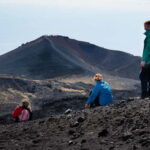
Meeting in Catania: simple pickup, small-group advantage
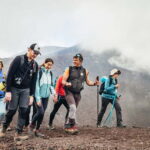
You’re picked up in Catania at one of two starting options: Anfiteatro Romano di Catania or Bar Ristorante Crateri Silvestri. The tour also returns you to your original meeting point, so you’re not stuck figuring out transport after a long day.
What matters here is the group size: it’s limited to 10 participants. On Etna, that’s a big deal. Smaller groups move more smoothly on uneven volcanic ground, and your guide can adjust how long you linger at viewpoints or where you slow down for footing. If you’ve ever been in a large group where everyone stretches out across different paces, you’ll appreciate how much calmer this feels.
Gear and the hike reality: what “basic fitness” really means
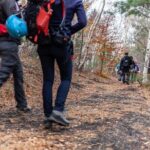
One reason I find this tour good value is the gear is handled for you. You get jackets, hiking shoes, and hiking poles. Socks aren’t included, so bring your own thin, comfortable pair. Also, sandals or flip-flops aren’t allowed—fair warning, lava terrain is not where you want to experiment with footwear choices.
The walk on volcanic material is about 6 kilometers on a 500-meter steep loop. That’s the key detail. Even if the overall distance doesn’t sound extreme, the steepness matters. Add the altitude—climbing from around 1,800 meters up to 2,400 meters—and you’ll feel it in your breathing and legs.
So here’s the practical take: if you can handle a challenging uphill walk for roughly a few hours, you’ll be in the right zone. If not, you might spend more time thinking about your pace than enjoying the crater views. Your guide will set the tempo, but the mountain won’t magically become flat.
What to bring is straightforward:
- sunglasses, sun hat, sunscreen
- daypack
- food and drinks (you’ll have a lunch break, but meals aren’t included)
- comfortable clothes and layers for mountain air
Stop-by-stop: what you’ll do from pickup to drop-off
Stop 1: Your Catania meeting point
You start at either Anfiteatro Romano di Catania or Bar Ristorante Crateri Silvestri. This is where you meet your group, get oriented, and get ready for the day’s height and terrain.
If you’re planning your day around this, I’d treat it like a half-day mission with a full-day feel. Even though the hike portion is a few hours, total tour time is listed as 7 hours, so plan to keep the rest of your schedule light.
You can also read our reviews of more hiking tours in Catania
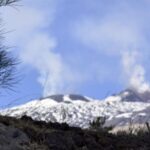
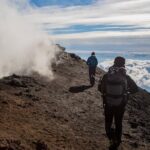
Stop 2: The guided Etna hike (around 3.5 hours)
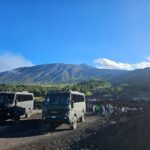
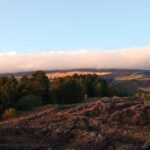
The main experience is a guided hike that runs roughly 3.5 hours, starting around 1,800 meters and moving up to 2,400 meters.
Along the way, you’ll walk through dramatic volcanic features:
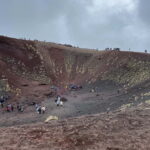
- cauldron-like hollows (large crater basins)
- summit craters
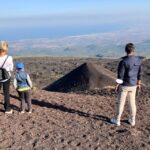
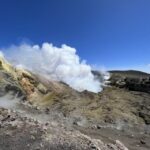
- lava rock formations and black lava sands
- views that open toward Valle del Bove, Calabria, and the Ionian Coast
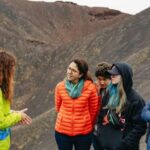
This is where the naturalist guide earns his pay. Instead of just naming places, he explains how eruptions shape what you see: where certain rock textures form, why the terrain looks the way it does, and what it means for life growing in a harsh volcanic environment. If you enjoy science that’s tied to real scenery, this is the sweet spot.
Lunch break at 2,400 meters
At about 2,400 meters, you stop for lunch. Food and drinks aren’t included, but sandwiches are available for sale before the hike, which is useful if you don’t want to pack everything from your hotel.
Lunch up here isn’t about fine dining. It’s about stillness and perspective. The air feels different, the scenery is huge, and you get that odd, calm contrast: silence of nature with the sounds of the volcano in the background. It’s a great moment to reset before you continue walking and (yes) enjoy the downhill lava-sand segment.
Stop 3: Return to your drop-off point
At the end, you’re dropped back at either Anfiteatro Romano di Catania or Bar Ristorante Crateri Silvestri, matching your start point. After this kind of hike, that matters. You’ll be tired in a good way, and you’ll want the simplest possible end to the day.
The view payoffs: Silvestri Craters and Valle del Bove
Etna gives you multiple viewpoints, not just one big photo moment. The route is built around seeing the volcanic geometry: hollows that look like huge bowls, crater areas that feel otherworldly, and the broad sweep toward Valle del Bove.
You’ll also get the colorful Silvestri Craters in your view set. The colors come from volcanic materials mixed and altered over time, and the visual effect is stronger when you’re higher up and closer to the scene. If you like landscape watching but hate crowds, this hike-style approach tends to feel more personal. You’re not standing shoulder-to-shoulder behind a railing; you’re moving through the terrain and stopping when it makes sense.
From certain angles, you can even take in distant regions including Calabria and the Ionian Coast. That’s the real payoff of climbing: the crater world connects to the human map around it.
Lava tunnels: what you gain, and what can change
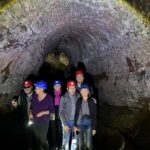
A major part of the experience is visiting a small lava cave and walking in the middle of black lava rocks and craters.
This is also where flexibility enters the picture. The cave visit depends on conditions. In case of strong tremors and eruptions, it won’t be possible to visit the lava cave, even if the eruption has ended. That’s not a trick, and it’s not about the guide changing their mind—it’s about safety and timing.
If the cave stop runs, you’ll get a different feeling than the open air sections. You’re still on volcanic ground, but now you’re experiencing volcanic history in a more enclosed space. It’s a nice contrast to the daylight panoramas.
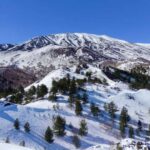
Also note: during winter season, the itinerary may vary due to snowfall. On a mountain, that’s normal. If you’re traveling in colder months, keep your expectations flexible.
Downhill on black lava sand: when “hike” turns into play
One of the highlights is explicitly built in: you can run downhill on the black lava sands.
This is the part that makes the tour memorable beyond the scenery. It’s not mandatory in the sense that you’ll be forced to sprint, but the terrain invites it. Black volcanic sand can feel surprisingly grippy in motion, and when you’re running downhill as a group, it creates that laugh-and-shake-off feeling you don’t get on most sightseeing walks.
Just keep it sensible. Poles help for balance, and the goal is to enjoy the ride without turning the hike into a fall risk. Your guide will manage the pacing and footing.
Naturalist learning that actually connects
I like tours where the guide ties the lesson to what you’re doing right now. Here, that’s the point. You’ll learn about:
- local flora and fauna in the Etna environment
- how volcanic conditions influence what can live there
- the geology of the volcano, using the formations you’re actively crossing
Because the group is small and the guide adjusts to your level, it’s easier to ask a question without feeling rushed. With Alessandro, the tour is also offered in English and Italian, and the English is said to be easy to understand even if your own English is average. That matters. Volcanos are already intense; you don’t want to struggle through technical explanations while your legs are burning uphill.
Price and value: is it worth $62.63?
At $62.63 per person, you’re not paying for a luxury vehicle or a guided experience that expects you to bring everything. The value comes from what’s included:
- pickup and drop-off
- jackets, hiking shoes, and hiking poles
- a guided hiking tour with naturalist-style interpretation
What’s not included is also clear:
- food and drinks
- cable car ride
- socks
Given that footwear and poles can cost money (and time) when you travel, the included gear is a real bonus. Food is the main extra you’ll probably handle yourself. The good news is sandwiches are available for sale before the hike, so you can manage lunch without having to plan a gourmet picnic at home.
In other words: for this price, you’re buying access to a guided volcanic hike with the tools to do it comfortably. If you were going to hike Etna independently, you’d still have transportation, interpretation, and gear to deal with. This takes a lot of friction out.
Who should book this Etna hike, and who should skip it
This tour is listed as not suitable for:
- children under 10
- pregnant women
- people with heart problems
- people with vertigo
- people with respiratory issues
- people who are prone to altitude sickness
- people over 70
Those limits aren’t there for fun. Altitude, steep terrain, and uneven volcanic ground aren’t forgiving, and the cave option adds enclosed-space conditions. If any of those health categories apply to you, it’s best to look for a different, less strenuous option.
Who it fits well:
- you want active volcano scenery, not just views from a roadside
- you like geology and nature learning that’s tied to what you’re seeing
- you’re okay with a steep uphill walk and a high point around 2,400 meters
- you prefer small groups where the guide can actually manage the pace
If you’re traveling with friends and you all enjoy moving outside, this is a great shared day. If you’re hoping for a gentle stroll, it may feel like too much.
Practical tips for a smoother Mount Etna day
A few things will help you have less stress and better fun:
- Bring food and drinks, because meals aren’t included. Use the sandwich sale before the hike if that’s easier.
- Pack sunscreen and a sun hat. Even when it feels cooler at altitude, UV is real.
- Wear comfortable clothes and plan for temperature swings.
- Use a daypack so you’re not carrying everything in your hands. Larger luggage or bags aren’t allowed.
- Expect basic physical effort. Don’t show up with the mindset of casual strolling.
- In case cave access is affected by tremors/eruptions, be ready for the day to shift. The open-air parts still deliver the main experience.
Should you book Mount Etna Guided Panoramic Trek?
Yes—if you want a guided hike that connects volcanic geology to real scenery, and you’re comfortable with a steep climb and high-altitude walking. The included gear and small-group format make it easier to do well, and Alessandro’s teaching style is the kind that helps the volcano make sense instead of just looking dramatic.
Skip it if you fall into the listed health restrictions, or if the idea of a steep 6 km loop at 2,400 meters sounds like a gamble for your body. In that case, you’ll enjoy Etna more with a calmer plan.
If you’re on the fence, my advice is to book with confidence—then prepare like you’re going hiking, not sightseeing.
FAQ
How long is the Mount Etna Guided Panoramic Trek?
The total duration is listed as 7 hours, with the guided hike taking about 3.5 hours.
Where does the tour start in Catania?
You start from one of two meeting options: Anfiteatro Romano di Catania or Bar Ristorante Crateri Silvestri.
How high do you hike on Mount Etna?
The hike goes from about 1,800 meters up to around 2,400 meters above sea level.
Is food included in the tour price?
Food and drinks are not included. There are sandwiches available for sale before the hike, and you’ll have a lunch break at 2,400 meters.
What gear is included?
The tour includes jackets, hiking shoes, and hiking poles.
What is not included?
Cable car ride, socks, food and drinks are not included.
Can the lava cave visit be canceled?
Yes. If there are strong tremors and eruptions, it may not be possible to visit the lava cave, even if the eruption has ended.
What is the hike distance and difficulty?
The walk on volcanic material is about 6 kilometers along a steep loop hike with a 500-meter steep section. Basic physical fitness is required.
What languages is the guide speaking?
The live tour guide offers English and Italian.
Is there free cancellation?
Yes. You can cancel up to 24 hours in advance for a full refund.