Ortigia at night is a different Syracuse. This guided evening stroll turns the island of Ortigia into a walk of sea-breeze comfort and historic-center lights, timed so the streets feel calmer than the daytime rush. I like the way the guide ties big sights to real local stories, and you’ll get a focused route in about two hours with a friendly, professional archaeologist guide: Italo Giordano.
The second thing I really appreciate is that the tour doesn’t just point at monuments. It also connects you to the Giudecca neighborhood and the story of the Jewish community, then winds through the most evocative places like Piazza Duomo and ends at Fonte Aretusa. One possible drawback: this experience depends on good weather, so if conditions are poor, you may be offered a different date or a full refund.
In This Review
- Key highlights worth knowing before you go
- Ortigia by night: why this 2-hour walk makes sense
- Starting at the Temple of Apollo (and why the date matters)
- Ortigia’s evening streets: learning the city by walking them
- Giudecca and the Jewish community story in the alleys
- Piazza Duomo after dark: the “thousand-year” square effect
- Ending at Fonte Aretusa: a calm finish point
- Italo Giordano and the small-group, private feel
- Price and what you actually get for $212.93
- Logistics that matter for an evening walk
- Should you book Ortigia by night with Italo Giordano?
- FAQ
- How long is the Ortigia by night guided tour?
- What is the price for the tour?
- Is the tour offered in English?
- Where does the tour start and end?
- Do I need a ticket to enter any sites on the tour?
- How do I get my ticket?
- What happens if the weather is bad?
- Is there a cancellation window?
Key highlights worth knowing before you go
- Ortigia after dark: sea breeze plus evening lighting for a more comfortable, atmospheric walk
- Italo Giordano (archaeologist guide): clear explanations and real context, in English
- Giudecca Jewish quarter storytelling: learned in the narrow alleys, not from a lecture hall
- Temple of Apollo stop: one of the oldest Greek stone temples, dating to the early 6th century BC
- Piazza Duomo at night: a square with a thousand-year presence in Syracuse
- Small private group vibe: your group stays together (up to 15 people)
Ortigia by night: why this 2-hour walk makes sense
This tour is built for an evening pace. You’re not trying to sprint through Syracuse. Instead, you’re moving through Ortigia at the right time of day, when the historic center looks better and feels less punishing than midday.
Ortigia is an islet, and it’s also treated like one of Syracuse’s neighborhoods. That matters because the walk stays concentrated. You’re not bouncing across the city. You’re learning how this compact part of Syracuse works—its streets, its landmarks, and the way different communities and eras left their marks.
I also like the “night logic.” The route is designed so you get a walk that’s easier in summer, when heat can mess with your plans. The reviews put a special emphasis on avoiding that daytime squeeze, and the idea fits the schedule: a short, guided stroll with evening light and sea air.
The tour is about two hours and is offered in English, which helps if you want guided interpretation without the hassle of switching languages or sorting through a self-guided audio app.
You can also read our reviews of more guided tours in Sicily

Starting at the Temple of Apollo (and why the date matters)
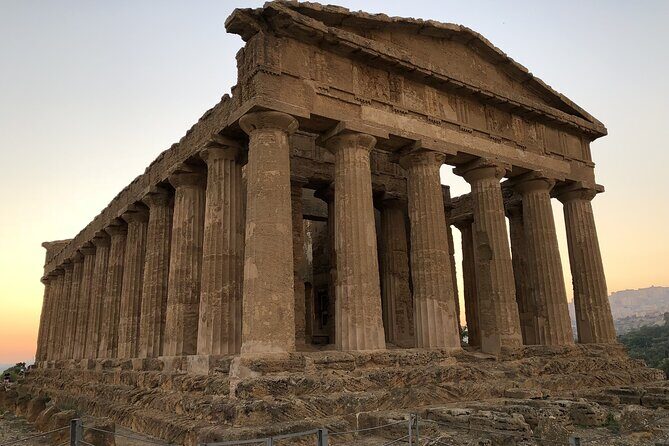
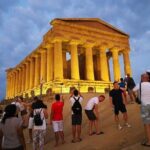
The walk begins at the Temple of Apollo, address listed in Syracuse. This isn’t a random starting point. It’s a strong anchor because you’re standing in front of one of the oldest Greek stone temples in Sicily.
The temple is described as being built at the beginning of the 6th century BC. That time period gives you a real framework for the evening. You’re starting in a Greek layer of Syracuse’s story, then moving forward into other cultural chapters you can actually see as you walk through Ortigia.
There’s also a practical note here: admission is listed as free at this stop. That’s a nice value add because it keeps the evening from turning into a ticket-and-wait situation.
If you’re the kind of traveler who likes to understand what you’re looking at, this start helps. You get the key Greek reference point first, so the later stops land with more meaning rather than feeling like disconnected photos.
Ortigia’s evening streets: learning the city by walking them
After the first anchor stop, the tour shifts into the neighborhood feel of Ortigia. This is where you start noticing how the island’s layout shapes the experience. Narrow streets, historic facades, and evening lighting do more than look pretty. They guide your attention—where the city’s energy sits, and how you move through it.
The tour framing is built for that moment when the historic center changes character. Nighttime lighting doesn’t just add mood; it clarifies outlines. If you’ve ever felt lost in a beautiful place, this is the opposite. You get a route and you follow it—so you can enjoy the details without constantly checking maps.
Also, the sea breeze element isn’t just a poetic claim. It’s part of why this timing works, especially in warm months. When the air cools a bit, a walk feels more doable, and you spend your energy on the sights instead of sweating through your itinerary.
Giudecca and the Jewish community story in the alleys
One of the most memorable parts of the evening is the section devoted to the Jewish community of Syracuse. The tour places this story in the Giudecca neighborhood on Ortigia, and it’s a key nuance that makes the explanation more accurate and more interesting.
You’re told that the Jewish community was one of the largest in the Mediterranean basin and that, at the time, it was integrated with society. It also matters that Giudecca is described as not being a ghetto, but simply a district of Ortigia. That framing changes how you interpret the streets. You’re not picturing a sealed-off area. You’re understanding a neighborhood that belonged to the wider island community.
The tour also covers the turning point: the Jewish population was expelled in 1492, and they never returned to live in Ortigia. You’ll walk through the narrow alleys of the Jewish quarter with that context, which is where the story gains weight. Instead of thinking about history as dates on paper, you’re seeing how the physical layout of a place can hold memories of what happened there.
There’s a reason this part earns strong praise. It’s not just a stop. It’s a guided way to connect space with time, and it’s done in a format that’s easy to follow on foot.
Piazza Duomo after dark: the “thousand-year” square effect
Next comes Piazza Duomo, and this is the kind of stop that makes night walks feel worth it. Piazza Duomo in Syracuse is described as one of the most evocative and beautiful squares in Italy, and it’s said to encompass a thousand-year history.
That’s a big claim, but the value for you is simpler: a square like this becomes more dramatic at night. Daytime crowds flatten details. At night, the edges of buildings and monuments read better, and the square feels like a stage for the city’s long timeline.
You’ll spend time in the square as part of the guided flow. You’re not just moving through it for a quick picture. The point is to pause and take in the atmosphere while the guide gives context.
If you enjoy the “slow look,” this stop is for you. It’s also a good moment to check in with the story you’ve heard so far. You started with Greek Syracuse at the Temple of Apollo, then moved through cultural layers like Giudecca. Piazza Duomo brings it together as the civic and architectural center you can feel in the space.
You can also read our reviews of more evening experiences in Sicily


Ending at Fonte Aretusa: a calm finish point
The tour ends at Fonte Aretusa, also listed in Siracusa SR. An ending point matters on short guided walks, because it changes how you’ll feel once you’re done.
Ending at a named location gives you a clean, practical finish. You’re not wondering where to “break” the evening. You’re simply arriving at the tour’s end, ready to continue your own night plan from there.
Even if you don’t know the meaning behind the name ahead of time, the fact that the tour is structured to stop at Fonte Aretusa helps your pacing. You know the route has a finish, and that keeps the two-hour experience from dragging.
Italo Giordano and the small-group, private feel
The guide behind the tour is Italo Giordano, listed as an archaeologist and tour guide. That background matters because you can often tell the difference between someone who recites facts and someone who explains what they mean.
The tour description and feedback you’re given point to a guide who’s not just passionate, but also practical and personable. People highlight that he goes out of his way to accommodate, and that he offers a strong restaurant recommendation when appropriate. That kind of add-on doesn’t cost you extra, and it can help you make the most of your evening once the walk is over.
The format is also private for your group. Pricing is per group (up to 15), which means you’re not getting absorbed into a giant crowd. For a night tour, that’s a big deal. A quieter group makes it easier to hear explanations, ask questions, and keep moving at the right pace.
The tour is offered in English, and service animals are allowed. It also notes that it’s near public transportation, so it’s easier to plan your arrival and departure without turning your evening into a logistics puzzle.
Price and what you actually get for $212.93
The price is listed as $212.93 per group, up to 15 people. That’s not the kind of pricing that fits everyone. It’s best when you can share the cost with others—friends, family, or even a small group you’re traveling with.
Here’s the value logic I’d use: you’re paying for a guided evening walk that includes interpretation of multiple historic sites in a compact area of Ortigia, plus the expertise of an archaeologist guide. You’re also getting a mobile ticket, and the Temple of Apollo stop is listed as free for admission.
If you’re traveling solo, the value depends on whether you find guided interpretation worth the cost versus doing some of Ortigia on your own. If you’re a couple or small family group, the per-person math usually feels more reasonable because the cost spreads across your group.
Also, a rating of 4.3 with 6 reviews suggests consistency. That doesn’t guarantee perfection, but it does tell me the core experience—guide quality and the night walking format—lands well.
Logistics that matter for an evening walk
This isn’t a huge, complicated tour on paper. It’s approximately two hours, offered in English, and you’ll receive confirmation within 48 hours of booking (subject to availability). You’ll use a mobile ticket.
The biggest real-world factor is weather. The tour states it requires good weather. If it gets canceled due to poor weather, you’ll be offered a different date or a full refund. For an Ortigia night walk, that’s sensible. Wet streets and low visibility can take the edge off the experience fast.
It’s also listed as most travelers can participate. If your group includes someone who needs to travel with a service animal, that’s explicitly allowed.
Finally, note the geography of the start and end points. You start at the Temple of Apollo area in Syracuse and end at Fonte Aretusa. If you’re planning dinner right after, you’ll want your next stop to be near the end point so you don’t lose time navigating in the dark.
Should you book Ortigia by night with Italo Giordano?
I’d book this if you want an evening in Syracuse that feels guided, not chaotic. The route hits multiple stops—Temple of Apollo, the Jewish quarter story in Giudecca, Piazza Duomo, and the finish at Fonte Aretusa—so you’re not guessing what matters most. The guide’s archaeologist background and the emphasis on accommodating, friendly explanations show that you’re in good hands.
Book it too if you’re visiting during hotter months. The night timing is part of the appeal, and the feedback around avoiding the daytime heat matches the tour’s structure.
Skip it or reconsider if you’re flexible about weather. Because it needs good conditions, you’ll want to plan around possible changes. If you hate itinerary uncertainty, keep that in mind.
If your idea of a great evening is a short walk with real context—Greek architecture, civic heart, and a grounded look at the Giudecca neighborhood—this is a smart fit.
FAQ
How long is the Ortigia by night guided tour?
It lasts about 2 hours.
What is the price for the tour?
The price is $212.93 per group, up to 15 people.
Is the tour offered in English?
Yes, the tour is offered in English.
Where does the tour start and end?
It starts at the Temple of Apollo in Syracuse (96100) and ends at Fonte Aretusa (96100) in Siracusa SR.
Do I need a ticket to enter any sites on the tour?
The Temple of Apollo stop is listed as admission free as part of the experience.
How do I get my ticket?
You’ll receive a mobile ticket.
What happens if the weather is bad?
The experience requires good weather. If it’s canceled due to poor weather, you’ll be offered a different date or a full refund.
Is there a cancellation window?
You can cancel up to 24 hours in advance for a full refund. If you cancel less than 24 hours before the start time, the amount paid is not refunded.