REVIEW · CATANIA
Typical Pottery Experience with local Artisans in Catania
Book on Viator →Operated by Curioseety SRLS · Bookable on Viator
Clay turns into souvenirs fast. In Catania, this studio visit is small-group and gives you real wheel time, plus tile painting with an expert guide, all in about three hours.
I also love the people factor: the artisans work patiently with your pace, and the tone is welcoming even when kids join in. Seeing how they guide hands-on work from first touch to finished decoration is a big part of why this feels special.
One consideration: your pottery isn’t ready right away. Pieces are fired over about 48 hours, and shipping (if you want it) comes with extra costs.
In This Review
- Quick reasons to book this Catania pottery studio
- A Catania pottery workshop that feels like a real studio
- Price and time: $75.70 for real craft time
- Meeting Ceramiche De Simone on Via Messina
- The order of the day: learn first, then make
- Stop in the studio: throwing on the lathe (wheel) with real guidance
- Painting your own decorative tile: where skill meets fun
- From your hands to the oven: 48 hours of firing
- Studio browsing without the hard sell
- Who this Catania pottery workshop suits best
- Practical tips so your hands behave (mostly)
- Should you book? My honest take
- FAQ
- How long is the pottery experience in Catania?
- What does the Catania pottery class cost?
- How large is the group?
- Is the class offered in English?
- Where is the meeting point?
- What’s included in the price?
- Do you make pottery and also paint a tile?
- How does the finished pottery get completed?
- Can they ship your piece overseas, and is shipping included?
- What is the cancellation policy?
Quick reasons to book this Catania pottery studio
- Wheel (lathe) time where you shape your own piece with step-by-step help
- Tile decoration class taught by an expert designer, with practical techniques for painting
- Small group (max 10 travelers), so you actually get attention at the bench
- Family-style studio feel, with warm instruction and translation support when needed
- Firing happens after class and overseas shipping can be arranged for an additional charge
A Catania pottery workshop that feels like a real studio
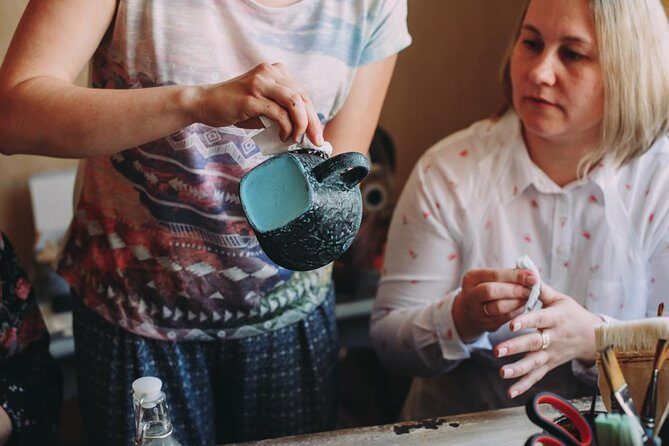
This isn’t the kind of pottery class where you just watch and do a one-minute craft. The experience starts in a working pottery studio in the heart of Catania, where you get a guided look at how Sicilian ceramics are made and then you put your hands on the clay.
You’ll spend time with artisans who know the craft and like teaching it. The shop setup makes it easier to see the flow of the process, from raw materials to finished pieces sitting ready for customers. And with a maximum of 10 people, you aren’t fighting for space, elbow room, or attention.
If you’re looking for a “do something with your hands” activity that still feels cultural, this is a strong match. The city setting helps too: you’re not heading out into nowhere. You’re working where the craft already lives.
You can also read our reviews of more tours and experiences in Catania.



Price and time: $75.70 for real craft time
At $75.70 per person for about three hours, this workshop lands in the middle of what you might expect for a hands-on ceramics class in a central European city. What makes it good value is what’s actually included: you get the studio visit, hands-on pottery time on the lathe (wheel), tile decoration, and an apron.
The part many people forget: pottery needs time to finish. Your piece gets fired later (about 48 hours). So even though the class is a short afternoon block, the experience really includes the finishing stage—especially if you choose to ship your work home.
What’s not included is also part of the value conversation. Souvenir purchases are extra, and shipping costs are extra. If you love the idea of making something you can’t easily buy, it’s still worth budgeting for the possibility of shipping.
Meeting Ceramiche De Simone on Via Messina
You’ll meet at Ceramiche De Simone, Via Messina 687, 95126 Catania. It’s near public transportation, so you should be able to reach it without turning your day into a taxi quest.
You’ll typically have a mobile ticket, and confirmation is sent at booking. Because this is a studio-based activity, arriving a few minutes early helps you settle in before the instructions start.
The studio is where the work happens, not a back room or temporary classroom. That matters. It means you can actually see the workflow around you, and it helps the class feel anchored in real craft rather than a packaged demo.
The order of the day: learn first, then make
You won’t start by jumping straight onto the wheel. You’ll begin with a short introduction that frames Sicilian pottery manufacturing—where the craft comes from, and how ceramics connect across generations and places.
Then the guide walks you through the steps of production. That’s useful because it gives your hands a reason for each step. You’re not just doing random motions; you’re learning what affects the final shape and decoration.
After this intro, you move into hands-on learning. This staged approach helps first-timers. The craft is complex, but you get the basics in the right order: understand the process, then practice the key technique, then paint.
Stop in the studio: throwing on the lathe (wheel) with real guidance
The highlight of the practical part is working at the wheel—the lathe—under artisan instruction. The goal is that you model your own ceramic piece, with coaching aimed at getting you from unsure hands to a shape that’s actually workable.
This is where the small group size pays off. You can get corrections while you’re doing the work, not after you’ve already moved on. And instructors are prepared to explain questions clearly; the experience is offered in English, and the studio also supports communication if translation is needed.
One of the standout details from what I’d call the “tone” of the workshop is patience. In particular, Giovanni is noted for guiding people with patience and good humor. That kind of teaching style matters with pottery, because the learning curve is real even when you’re doing everything right.
You may also be introduced to other tools during the session. One person noted getting familiar with a press as well as the wheel. Even if your focus stays on the wheel, expect to leave with a better sense of how different tools affect texture and form.






Painting your own decorative tile: where skill meets fun
Right after (or alongside) wheel time, you’ll get a tile decoration class. This is more than just grabbing a brush and making marks. You’ll learn a way to paint that looks intentional and matches the ceramic style you’re working within.
A fun reality: tile painting can be harder than people expect. One birthday student described it as surprisingly tough, even for someone who picked up the technique quickly. That’s a good sign. It means the class isn’t “paint whatever you want and call it pottery.” You’re learning methods that help your tile look finished.
The guide in this part is described as an expert designer, and that shows in how they talk about decoration. Expect direction on how to handle paint placement, keep control, and finish with a design that looks like a true craft item rather than a rushed souvenir.
If you like crafts where precision is part of the satisfaction, this section is likely to land well.
From your hands to the oven: 48 hours of firing
Once your work is done, your pieces go into the special oven to be cooked. The firing time is about 48 hours of cooking. That means you’re not taking your final pottery away the same afternoon.
This is also where planning helps. If you want your finished piece at home, the studio can arrange shipping, but shipping is an extra charge. If you’re traveling light, you can think of this as a win: you don’t need to carry fragile fired work around Sicily.
The trade-off is timing. Your piece is worth waiting for, but it won’t be ready instantly. If you’re the type who hates the “wait and see” part of crafts, you might find this annoying. If you’re okay with waiting, it’s a nice way to leave with something meaningful without lugging it through your trip.
Studio browsing without the hard sell
After the making and painting, there’s time to look around the ceramic shop and see finished works. You can pick up souvenirs too, but the style of selling is described as comfortable, not pushy.
This matters because pottery shops can sometimes turn into sales marathons. Here, the focus stays on your class and your finished work, with shopping as an optional bonus if you want it.
If you end up buying something, you’ll already understand how hard it is to create and decorate pieces. That makes the purchases feel more intentional, not random.
Who this Catania pottery workshop suits best
This workshop is ideal for people who want hands-on learning and don’t mind slowing down for a craft. Couples often like it because you get a shared activity with personal outcomes. Solo travelers like it for the attention they get at the wheel.
It can also work well for families. One family came with kids ages 6, 4, and 1, and the instruction was described as especially warm toward children. Kids can participate, and the artisans were patient and kind. If you’re bringing younger kids, expect to do some watching and assisting, but the studio setup is built to handle real groups.
English is the offered language, and most travelers can participate. If you have mobility concerns, you’ll want to ask about your specific situation in advance since the data only says most travelers can join. Still, the experience is run like a working studio, so you’re not stepping into a highly technical lab.
Practical tips so your hands behave (mostly)
A few things will make your class smoother:
- Wear clothes you’re okay with getting stained. You’ll get an apron, but pottery can still be messy at the edges.
- Give yourself time to focus. This isn’t a quick stop between museums. The learning takes a bit of attention.
- Ask questions as you go. Wheel work especially improves when you get corrections mid-action.
- Plan for the “not today” reality. Your fired piece needs time, and shipping has extra costs.
- Decide early if you’ll ship. If overseas shipping matters for your schedule, it’s better to think about it before you finish your design.
Also, keep in mind the tour ends back at the meeting point. So you can build the rest of your afternoon around returning to the central area of Catania.
Should you book? My honest take
Book it if you want a genuinely hands-on Catania experience that mixes technique with creativity. The included wheel time, the tile decoration class, and the small-group setup are what make this stand out from casual craft demos.
Don’t book it if you’re only interested in taking something home immediately. Your piece is fired after class, and shipping costs extra if you want it delivered. If you’re strict on timing, you’ll need to be okay with waiting.
Finally, this is a great choice when you’re tired of the “look-only” side of travel. You’ll leave with something you made, plus a clearer sense of how Sicilian ceramics are shaped and decorated.
FAQ
How long is the pottery experience in Catania?
It lasts about 3 hours.
What does the Catania pottery class cost?
The price is $75.70 per person.
How large is the group?
The workshop has a maximum of 10 travelers.
Is the class offered in English?
Yes, it is offered in English.
Where is the meeting point?
Meet at Ceramiche De Simone, Via Messina, 687, 95126 Catania CT, Italy.
What’s included in the price?
Included are the pottery studio visit, hands-on ceramic work on the lathe (wheel), tile decoration class, and an apron.
Do you make pottery and also paint a tile?
Yes. You’ll work on the wheel to make your pottery piece and also decorate a tile.
How does the finished pottery get completed?
After the class, your ceramics are cooked in a special oven for about 48 hours.
Can they ship your piece overseas, and is shipping included?
Overseas shipping can be arranged for an additional charge. Souvenirs and shipping charges are not included.
What is the cancellation policy?
You can cancel free of charge up to 24 hours in advance for a full refund. If you cancel less than 24 hours before the start time, the amount paid is not refunded.