REVIEW · SICILY
Palermo Street Food tour: art, history and ancient markets
Book on Viator →Operated by Palermo a Piedi - Walking Tour · Bookable on Viator
Street food here comes with a side of history. This 3-hour walk in Palermo connects what you eat with what you see, from the Cathedral area to the Quattro Canti and the ancient Cassaro. I like that the tour is built around real street stops and not just photo ops, with a guide who ties meals to the city’s layered past.
Two things I particularly like: first, you get a lineup of Palermo favorites, including panelle, crocchè, sfincione, arancina, and cannolo, plus more classic bites at the Arab-market area. Second, you also get major historic anchors—Teatro Massimo, Palermo’s Cathedral, Quattro Canti, Piazza Olivella, and Via Vittorio Emanuele—so the food has context, not just carbs.
One consideration: this is still a walking tour, and it requires good weather, so plan for comfort and bring layers if Palermo gives you surprise wind or sun.
In This Review
- Key highlights you’ll feel fast
- Why Palermo street food works better on foot
- Getting your bearings: Piazza Olivella to Quattro Canti
- Capo Street Market: the Arab-market feeling in real time
- Dainotti’s da Arianna: friggitoria energy and fried-food skill
- Teatro Massimo and the Cathedral: big-city monuments in walking distance
- Quattro Canti and Piazza Olivella: urban geometry and church power
- Teatro dell’Opera dei Pupi: Sicilian storytelling with UNESCO weight
- Via Vittorio Emanuele (the Cassaro): Palermo’s main stage
- What you’ll taste: Palermo classics you can actually compare
- Price and what $49.77 buys you in Palermo
- Guides who make the city feel personal
- Should you book this Palermo street food walk?
- FAQ
- How long is the Palermo Street Food tour?
- How much does the tour cost?
- What street food is included?
- Is a drink included?
- What major sights are visited?
- Where does the tour start?
- Where does the tour end, and how far is it from the port?
- Is museum admission included?
- How big is the group?
Key highlights you’ll feel fast
- Capo Street Market from the start: Arab-origin food lanes you cross on foot, right in the historic center.
- Dainotti’s friggitoria stop: a Fried-food specialist tied to a TV competition for Palermo street food.
- Cathedral visit without the fuss: the Cathedral stop is scheduled as free-entry time.
- Quattro Canti and the Cassaro route: you see the city’s main cross-streets and its old “spine.”
- Puppet-Opera tradition link: a stop includes the Teatro dell’Opera dei Pupi by Mimmo Cuticchio, noted as UNESCO heritage.
- Small group energy (max 16): easier pacing, quicker questions, and more room to focus on what you’re tasting.
Why Palermo street food works better on foot
Palermo street food isn’t just snack culture. It’s a living map of the city—Norman, Arab, Spanish, and local working-class life all stacked together in one bite. A walking tour format matters here. You’re not trapped in a single restaurant. You move through the neighborhoods where the food actually lives.
I love that this tour is structured to keep you eating while you’re still fresh enough to enjoy the sights. You’re in the historic center, near the big monuments people come to see, and you also get the market atmosphere that explains why Palermo’s food tastes the way it does.
You’ll also leave with a better sense of what to look for on your own. The guide isn’t just narrating buildings. You’re guided to what’s worth ordering next, plus where to continue eating and drinking after the final stop.
You can also read our reviews of more food & drink experiences in Sicily
Getting your bearings: Piazza Olivella to Quattro Canti
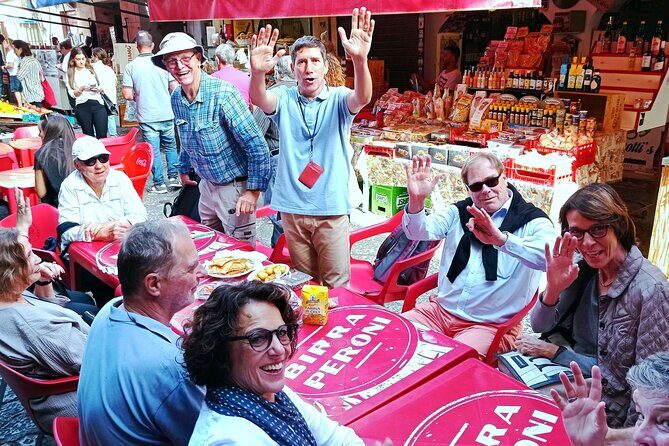
The tour begins at Piazza Olivella (90133 Palermo). From there, you’re walking deeper into the historic center and heading toward the area around Quattro Canti, the octagonal square formed where two of Palermo’s main streets meet.
This is a smart route choice for first-timers. Piazza Olivella is a recognizable anchor point, and it positions you to see key landmarks in a tight loop rather than crisscrossing the city. The tour ends near Quattro Canti, and that matters if you’re thinking about lunch, museums later, or catching a ride.
If you’re on a cruise, the timing is also built around you. There’s a meeting at the port at 10:00 for cruise passengers, while the tour itself starts at 10:30. The end point is not at the port, but it’s about a 20-minute walk away, with taxi parking nearby to get back.
Capo Street Market: the Arab-market feeling in real time
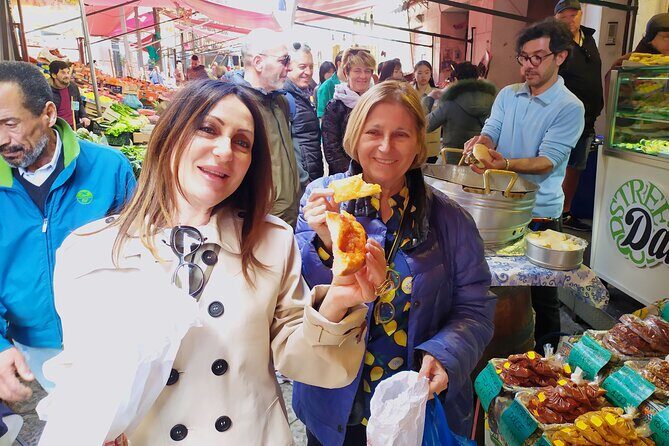
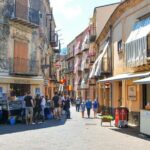
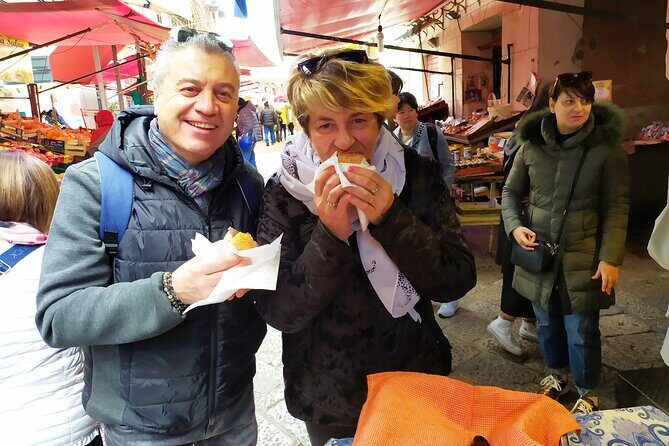
Your first food stop is Capo Street Market, in the area along Via Porta Carini and Via Bandiera. This is one of those places where you immediately get why Palermo works. People come here daily, not just for tourists. You can feel that routine in the narrow lanes and in how the food stalls operate.
What’s special is the Arab origin angle, which sets the stage for how Palermo absorbed and reshaped cultures over centuries. Even if you’re not hunting for academic connections, the market gives you something more practical: a crash course in local tastes. You’ll see what’s being sold, how quickly it moves, and what locals consider normal.
This stop also tends to be a great momentum builder. When you start with food, you stop thinking of the tour as a lecture. Instead, you’re learning with your stomach. And yes, you’ll likely get more than one sample, so don’t show up starving.
Dainotti’s da Arianna: friggitoria energy and fried-food skill
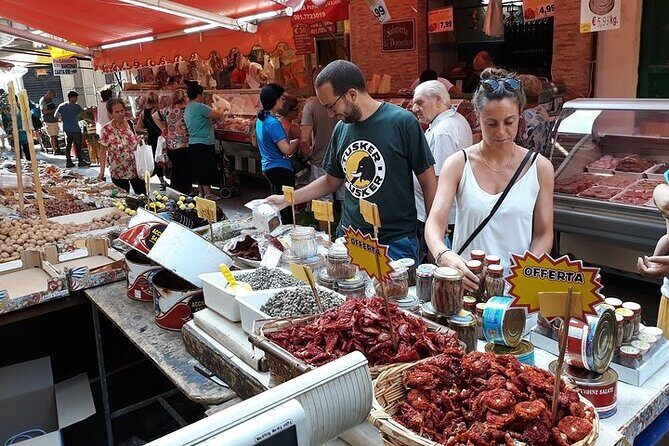
Next you head to Dainotti’s da Arianna, a friggitoria stop that’s framed as one of Palermo’s best fryers. The important part isn’t the hype. It’s that the stop is designed around street food competence: oil, timing, and technique.
You’re given about 45 minutes here, which is long enough to eat without rushing and still feel like you’re part of the rhythm. The tour is also set up with this stop as a “fill you up” moment, not a tiny appetizer. That’s helpful if you’re doing the walk midday and want your energy for the rest of the sights.
In the guide’s hands, this can turn into a food lesson. I like when a tour shows you the logic behind Sicilian classics—what makes something crisp, what keeps it from going soggy, and what flavors get amplified by frying.
One practical note: fried street food adds up. Plan for it. If you have a sensitive stomach or you prefer lighter meals, you’ll want to pace your samples and maybe save room for the cannolo later.
Teatro Massimo and the Cathedral: big-city monuments in walking distance
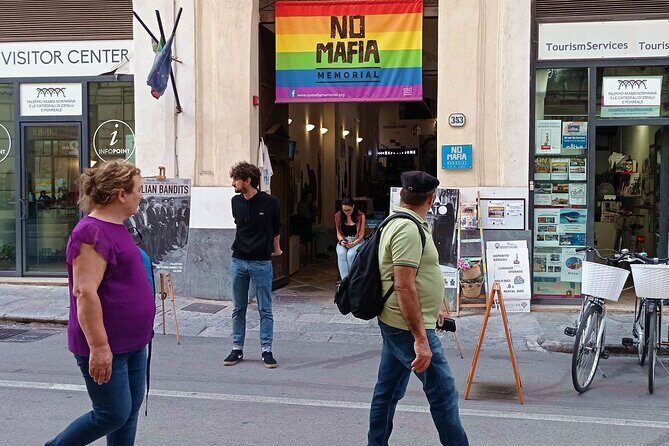
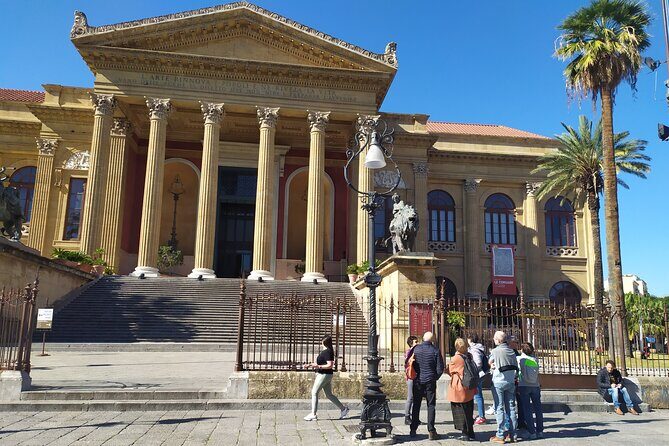
As you move through the historic center, you’ll pass the Teatro Massimo, described as the largest opera house in Italy. Even if you don’t go inside, seeing it from the street changes your sense of Palermo. It’s proof the city isn’t only markets and churches—it also invested in big stages and cultural institutions.
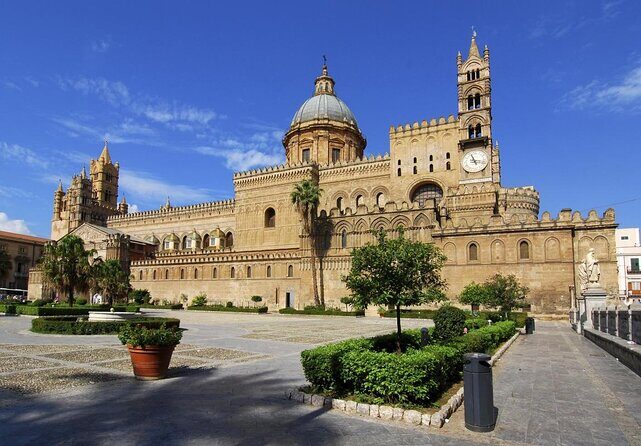
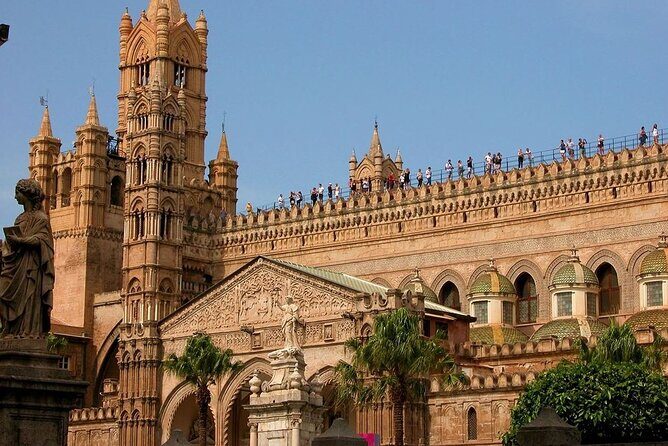
Then you reach the Cathedral of Palermo, the main Catholic place of worship and the seat linked to the archbishopric. Built in the 12th century, it sits in the UNESCO Arab-Norman itinerary story (together with Monreale and Cefalù) since 2015. That UNESCO connection is valuable because it explains why the Cathedral area feels like a crossroads instead of a single-style monument.
The tour schedules a Cathedral visit with admission time labeled free. In practice, this means you’re not stuck hunting for extra tickets. You can focus on the architecture and the layers of artwork added over time. And since it’s a walking tour, you’ll have a guide translating what you’re seeing into a timeline you can remember.
You can also read our reviews of more tours and experiences in Sicily

Quattro Canti and Piazza Olivella: urban geometry and church power
At Quattro Canti, you get one of Palermo’s most scenic “street intersections turned landmark.” The square is octagonal and built in the early 1600s where Via Maqueda and the Cassaro meet (today Via Vittorio Emanuele). The idea is simple but genius: you don’t just cross the street. You arrive at a designed setting.
This stop is quick—about 10 minutes—but it’s the kind of stop that makes the rest of your walk easier to navigate. Once you understand where Quattro Canti sits, the city’s main streets snap into focus. You start noticing sightlines you would otherwise miss.
Then you move to Piazza Olivella, centered around the church of Sant’Ignazio. Nearby is the former Convento, which houses the Archaeological Museum. Even if museums aren’t your priority on this day, the area is still worth the stop because it adds another layer: Palermo’s religious and cultural institutions overlap here like they do in many historic cities.
Teatro dell’Opera dei Pupi: Sicilian storytelling with UNESCO weight
In the route, you also stop for the Teatro dell’Opera dei Pupi by Mimmo Cuticchio. Opera dei Pupi is a typical Palermo show tradition dating back to the 1800s, and it’s noted here as UNESCO heritage.
Why include this in a street-food tour? Because it fits the theme. Palermo isn’t only food and monuments. It’s performance and memory too. Puppet-opera storytelling is one of the ways communities kept tales alive, and it belongs in the same conversation as historic streets and long-lasting institutions.
Even if your day is mostly about eating, this cultural stop adds texture. You’ll feel like you saw a whole city, not just a route of famous photo stops.
Via Vittorio Emanuele (the Cassaro): Palermo’s main stage
Your final major sightseeing stop is Via Vittorio Emanuele, also known as the ancient Cassaro. This is described as the oldest street in Palermo, lined with palaces, churches, and convents.
This is a smart closing move. By the time you reach the Cassaro, you’ve already eaten and you’ve already seen the major anchors. Walking this corridor helps connect everything into a single mental map. You’re not just collecting stops; you’re connecting the dots between food, architecture, and city layout.
The Cassaro also helps you understand why so many landmarks feel “in the middle of things.” This is Palermo’s long, central spine—so when you look around, you’ll notice how the city’s historic power structures and everyday life overlap along the same routes.
What you’ll taste: Palermo classics you can actually compare
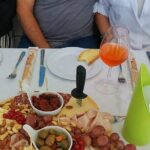
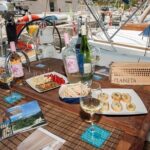
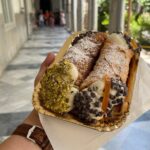
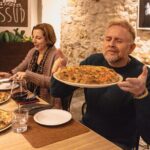
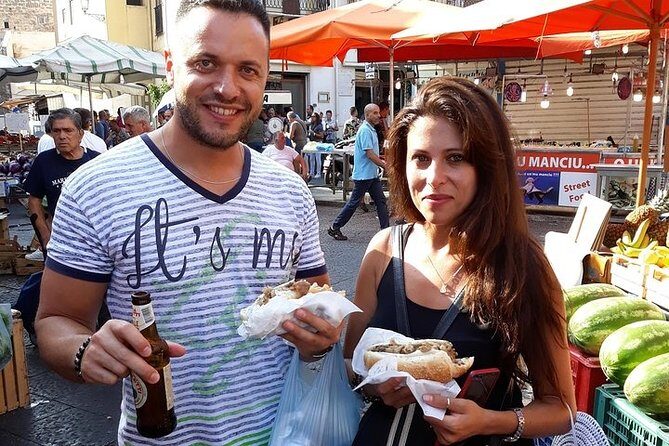
The tour tasting is designed to cover a range of Palermo flavors, not just one style of snack. Included are panelle, crocchè, sfincione, arancina (often spelled arancina in English), and cannolo, plus a drink of your choice: water, cola, or beer.
You’ll also be introduced to other famous street foods connected with the Arab market area, including meusa (spleen sandwich) alongside panelle and arancini. So even if you’re selective, you’ll have a chance to see the full spread of what Palermo considers normal street fare.
Here’s how to think about it while you’re eating:
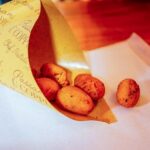
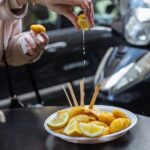
- Panelle: chickpea fritters that show up as a street staple. Look for the balance between crunch and softness.
- Croccchè: another fried classic, usually potato-based, with a different texture than chickpea.
- Sfincione: a hearty Sicilian style, which tends to feel like comfort food rather than a light snack.
- Arancina/arancini: rice balls that bring a savory core and a more filling bite.
- Cannolo: your sweet finish, and usually the moment you realize your tour meal was more like lunch.
The big advantage here is comparison. Instead of tasting one dish and calling it done, you’re tasting a mini menu that lets you recognize your favorites. That makes it easier to order later when you’re on your own.
And the guide’s role matters. You’ll get advice on where to continue tasting the best foods, drinks, and desserts after the tour ends. That kind of practical guidance turns a one-day experience into a week-long food plan.
Price and what $49.77 buys you in Palermo
At $49.77 per person, you’re paying for three things at once: a guided walking tour of the historic center, access time for key sights, and a structured street-food tasting with a drink.
You’re not just paying for food. The route combines markets and landmarks—Capo Street Market, the Cathedral of Palermo, Quattro Canti, Piazza Olivella, and Via Vittorio Emanuele. For many cities, doing that on your own usually means either paying for multiple tickets or spending too much time figuring out what’s worth your attention.
On top of that, the tour includes specific tastings and a drink choice (water, cola, or beer). Food tours can feel pricey when the tasting is tiny, but this one is built to be filling across multiple stops.
The small group cap (maximum 16 people) is another value factor. In a larger crowd, food tours can turn into line management. Here, the format is set up so you can ask questions and still keep moving at a comfortable pace.
Guides who make the city feel personal
The experience is led by an expert, authorized guide, and the energy you get matters. In particular, I like the way the tour is described as interactive and question-friendly, with guides who learn names quickly and add local color rather than just reciting facts.
Names you may hear associated with the tour include Fabrizio and Maurizio, both described as Palermitani guides with strong knowledge and a friendly style. That local perspective is useful. Palermo can feel complicated at first. A good guide helps you connect the dots without turning it into a school report.
Also, the tour has a clear practical payoff: once you know the patterns of the streets and what to order, you can keep eating after the walking ends.
Should you book this Palermo street food walk?
Book it if you want your first day in Palermo to do two jobs at once: get you grounded in the historic center and feed you Palermo classics without you guessing where to start. This is especially good if you like the idea of learning through eating—markets first, then monuments, then a final walk along the Cassaro.
Skip it or modify your expectations if you need a very slow pace. You’ll be walking for about 3 hours, and it depends on good weather. Also, museum admission fees aren’t included, so if you’re planning a major museum day, you’ll want to budget extra.
If you’re doing Palermo on a tight schedule, this tour is a smart way to get the city’s main threads—street life, religious landmarks, and cultural tradition—into one afternoon meal-and-walk plan.
FAQ
How long is the Palermo Street Food tour?
The tour is about 3 hours long.
How much does the tour cost?
The price is $49.77 per person.
What street food is included?
Included tastings include panelle, crocchè, sfincione, arancina/arancini, and cannolo.
Is a drink included?
Yes. A drink of your choice is included: water, cola, or beer.
What major sights are visited?
You’ll visit the Cathedral of Palermo, see Quattro Canti, pass through Via Vittorio Emanuele (the ancient Cassaro), and include stops connected to Teatro Massimo and the opera dei pupi tradition by Mimmo Cuticchio.
Where does the tour start?
The tour starts at Piazza Olivella, 90133 Palermo.
Where does the tour end, and how far is it from the port?
It ends at Quattro Canti (Piazza Vigliena). The end point is about 20 minutes walking distance from the port.
Is museum admission included?
No. Museum admission fees are not included.
How big is the group?
The tour has a maximum of 16 travelers.