REVIEW · PALERMO
Palermo: alla scoperta dei suoi monumenti, storie e mercati
Book on GetYourGuide →Operated by Antonella · Bookable on GetYourGuide
Palermo feels like a living movie set. I love how this walk ties UNESCO landmarks to real stories you can picture on screen, and I love the quick taste at the Arab-origin stalls of Mercato del Capo. One thing to plan for: the tour is Italian only, so if you’re not comfortable with the language, you may miss some of the punch lines and context.
The guide style matters here. Antonella (and also other guides like Fabrizio on some days) are praised for explaining hidden meanings, keeping the pace moving, and sharing practical ideas for what to eat and where to pause. The route is also listed as wheelchair accessible, and at least one booking specifically called that out.
You’ll be walking in the historic center for about 3 hours, from Teatro Massimo to Piazza Pretoria. Since the Cathedral is part of the route, you’ll also want to come dressed modestly to enter.
In This Review
- Key highlights worth your time
- Palermo on foot: why this route makes sense
- Teatro Massimo: a Belle Époque star with Florio family roots
- Opera dei Pupi and the UNESCO puppet tradition
- Palermo Cathedral (UNESCO): crowned in 1130, Frederick II’s tomb
- Mercato del Capo: Arab-origin market atmosphere and street-food taste
- Cassaro to Quattro Canti: the oldest street meets the city’s historic crossroads
- Piazza Bellini: coffee, sweets, and a break in the middle
- Piazza Pretoria: the fountain of Shame, plus a natural lead-in to Ballarò and Vucciria
- Price and logistics: what $41 buys you (and what it doesn’t)
- The guide experience: passion, competence, and no dead time
- Who should book this tour, and who might skip
- Should you book this Palermo monuments and markets tour?
- FAQ
- How long is the Palermo walking tour?
- Is the tour offered in languages other than Italian?
- Where do we meet the guide?
- Are entrance fees included?
- Is food included?
- Is there a dress code for the Cathedral?
- Is the tour wheelchair accessible?
- Can I cancel and get a refund?
Key highlights worth your time
- Teatro Massimo: the largest theatre in Italy, plus the Florio family connection
- Cathedral of Palermo (UNESCO): multiple architectural styles, crowned in 1130, and Frederick II’s tomb
- Mercato del Capo: Arab-origin market energy and a street-food tasting stop
- Cassaro: Palermo’s oldest street, packed with history
- Quattro Canti + Piazza Bellini: historic crossroads and a classic coffee break area
- Piazza Pretoria: the fountain of Shame near Ballarò and Vucciria
Palermo on foot: why this route makes sense
Palermo is the kind of city where the best “facts” are the ones you can see with your own eyes. On this tour, you cover the tight, story-heavy core of the center, so each turn adds a new layer: empire, religion, trade, and everyday life in the markets.
The value here is how the guide connects monuments to context. You don’t just see buildings. You hear why they matter, and how films, novels, and TV series have helped turn places into characters. If you want a first-time orientation that still feels authentic (not a checklist), this is the style that works.
Also, the tour is short enough to stay fun. In 3 hours, you get the major stops plus a couple of “pause and taste” moments, without feeling like you need a full day to make it worthwhile.
You can also read our reviews of more tours and experiences in Palermo.
Teatro Massimo: a Belle Époque star with Florio family roots
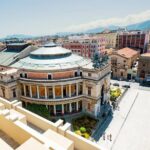
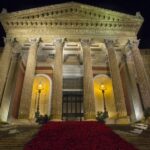
The tour starts at Teatro Massimo, the biggest opera house in Italy. That size alone is impressive, but the real point is what the building represents: Palermo’s ambition during the Belle Époque, when money, culture, and local power were all rising together.
You’ll hear the Florio family mentioned here. They’re tied to Palermo’s growth in the 19th century, and Teatro Massimo is the kind of landmark that makes you understand why wealthy families invested so heavily in public culture. Even if opera isn’t your thing, the theatre works as a “how Palermo got modern” reference point.
Practical note: this is the start of your walk, so arrive with your energy up. Wear comfortable shoes, because the day’s theme is “historic center,” not “sit-and-stroll.”
Opera dei Pupi and the UNESCO puppet tradition
From Teatro Massimo, you pass the famous Opera dei Pupi theatre. These Sicilian puppet traditions are a UNESCO-listed cultural heritage, and the stop is useful even if you don’t know the topic yet.
I like how this kind of moment broadens what “heritage” means in Palermo. It’s not only grand stone. It’s also the stories that people acted out, taught, and kept alive—often with local heroes and dramatic plots that shaped popular culture.
Even a brief stop helps. You’ll be able to look at what you see and connect it to the bigger idea: Palermo’s identity has always mixed art forms, languages, and audiences.
Palermo Cathedral (UNESCO): crowned in 1130, Frederick II’s tomb
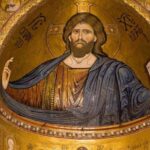
Next comes the Cathedral of Palermo, also UNESCO-listed. It’s an easy stop to love because the building itself shows the multi-ethnic history of Sicily. Different architectural styles sit side by side, so you can literally watch the city’s layers.
The guide highlights two big story anchors. In 1130, the first king of Sicily was crowned here. And the tomb of Frederick II is here too, which connects the cathedral to the medieval power map of southern Italy and beyond.
There’s a practical side as well. You’ll need modest clothing to enter. If you’re traveling in warmer weather, plan ahead so you don’t get stressed at the door. Also, entrance is free (so you avoid one of the common tourist “gotchas” in churches).
Mercato del Capo: Arab-origin market atmosphere and street-food taste
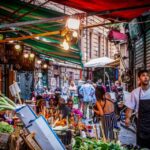
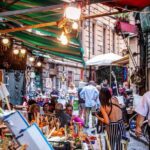
Then you hit Mercato del Capo, described as an ancient market of Arab origin. This is the emotional contrast to the cathedral: religion and empire on one block, daily trade and food culture on the next.
The market is known for its fish restaurants, and the guide’s job is to help you see what you’re looking at. Market geography matters here. Stalls, smells, and crowds tell you how locals shop and eat—not just how tourists browse.
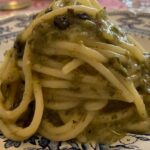
The best practical bonus is the short street-food tasting stop. You get a chance to taste Palermo street food during the tour (food isn’t included overall, but the tasting moment is part of the experience). One review noted especially good recommendations for cannoli and gelato, so don’t be shy asking what the guide suggests pairing with your snack.
Tip: markets are where you’ll get your most local-feeling photos, but they’re also where patience helps. If you want the smoothest experience, don’t plan tight timing for right after the tour ends.
Cassaro to Quattro Canti: the oldest street meets the city’s historic crossroads
After the market, the route crosses the Cassaro, Palermo’s oldest street. It’s one of those urban spines where the city’s history piles up in layers along the same path. As you walk, you’ll see how commerce, religion, and politics shaped what was built—and where people wanted to be.
From there you stop at Quattro Canti, a key center point in historic Palermo. It’s often used as a film set, and that makes sense once you see it. The square is designed like a visual intersection: multiple corners, strong symmetry, and architectural drama.
This part of the tour is where the guide’s storytelling really earns its keep. If you like legends, mysteries, and the idea of Palermo as a city that tells tall tales, this is the moment. The monuments stop being “objects” and start becoming scene-starters.
Piazza Bellini: coffee, sweets, and a break in the middle
Next is Piazza Bellini, another classic historic area where you can pause. The tour suggests a coffee stop in the square area, and it’s framed as among the best in the world. Even if you don’t judge by that standard, it’s a smart move: you’re about halfway through the walking loop, and a break makes the last stretch easier.
From here you’ll hear about the sweets tied to the nuns of Santa Caterina. This is the kind of detail that turns food into history. A pastry isn’t only a snack; it’s a trace of how religious communities contributed to local everyday life.
If you have a sweet tooth, you’ll be glad this stop exists. It balances out the more intense history moments, and it gives you a chance to reset before the tour heads toward the final landmark.
Piazza Pretoria: the fountain of Shame, plus a natural lead-in to Ballarò and Vucciria
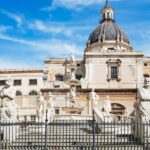
The tour ends near the markets of Ballarò and Vucciria at Piazza Pretoria. The star here is the fountain of Shame, a striking feature that looks like decoration until you learn how it fits into the story of the place.
It’s also a good ending location because it sits right next to where you’d likely want to wander afterward. You’re close to more market atmosphere, and the route lets you finish with something visually memorable rather than just “one more church.”
Around Piazza Pretoria, you’ll also notice the monasteries, churches, and palaces that shape the historic center’s look. The guide’s focus helps you read the area instead of just glancing at it. You start to understand Palermo as a city built for layers—some official, some messy, some beautiful, some complicated.
Price and logistics: what $41 buys you (and what it doesn’t)
This experience costs $41 per person for about 3 hours of walking with a professional guide in Italian. For that price, you’re not just getting a route—you’re getting guided interpretation of UNESCO monuments, a market stop with a street-food moment, and a story framework that makes the center easier to understand afterward.
What’s not included: entrance fees and food/drinks. The Cathedral entrance is free, which is a nice break. But you should still expect to spend a bit if you choose to buy snacks or sit for coffee at Piazza Bellini.
The other logistics point is language: Italian only. If you speak little Italian, consider using simple translation tools and staying flexible about how much story you catch. Even without every word, the order of stops still helps you orient yourself.
The guide experience: passion, competence, and no dead time
The most praised part of this tour is the guidance itself. Antonella is highlighted for explaining hidden meanings behind each place with passion. Fabrizio is also praised for being competent, with a tour that stays informative without turning into a lecture.
You can also feel the variety in the content: monuments plus films, novels, TV series, legends, mysteries, heroes, and mafia-related stories. That mix keeps the tour from feeling like history only. It’s a reminder that Palermo’s past is still used to explain the present.
Another strong theme in the feedback: the pacing. People explicitly mentioned there was no boredom and that the tour stayed varied. That matters on a walking route, because the wrong pace turns “3 hours” into “3 hours of standing around.” Here, the structure keeps you moving.
And if you care about practical eating ideas, the guide style includes food tips—like pointers for cannoli and gelato choices. It’s a smart add-on because it lets you continue your own Palermo day afterward with less guesswork.
Who should book this tour, and who might skip
I’d book this if you’re:
- visiting Palermo for the first time and want a clear center orientation
- interested in UNESCO sites and how they connect to real historical timelines
- the type who enjoys storytelling—films, novels, local legends, and the darker myths as well as the monuments
- looking to add market-food culture to your day, without spending hours planning
I’d think twice if:
- you don’t speak Italian and you strongly prefer a full, word-by-word explanation
- you’re hoping for a lot of inside time in multiple buildings (this is built as a walking tour with key stops, and some experiences may be exterior or limited to what you can access)
Also, bring modest clothing expectations seriously for the Cathedral. It’s one of those small items that can make or break your entry.
Should you book this Palermo monuments and markets tour?
Yes—if you want a guided walk that makes the center feel understandable fast. For $41, you get a tight loop through major Palermo landmarks, a market moment tied to Arab-origin history, and a guide who knows how to turn stone and streets into stories you can remember.
I’d book it especially if you like your sightseeing with context, not just photos. And if Italian is a challenge, go anyway with the mindset that you’ll still learn a lot from what you see—even if you catch only parts of the commentary.
FAQ
How long is the Palermo walking tour?
The tour lasts 3 hours.
Is the tour offered in languages other than Italian?
No. The tour is in Italian only.
Where do we meet the guide?
You meet in front of the Banca d’Italia. The guide has a card that says Guida Turistica.
Are entrance fees included?
Entrance fees are not included. The Cathedral entrance is free.
Is food included?
Food and drinks are not included, but there is a short stop where you can taste famous Palermo street food.
Is there a dress code for the Cathedral?
Yes. You must wear modest clothing to enter the Cathedral.
Is the tour wheelchair accessible?
It is listed as wheelchair accessible.
Can I cancel and get a refund?
Yes. You can cancel up to 24 hours in advance for a full refund.